

A real estate investment firm needs daily home prices across twenty US cities. A property platform wants to display rental listings from dozens of local sources. A mortgage lender tracks market trends at the ZIP code level.
MLS databases hold the gold standard data, but accessing them costs thousands per month. Many firms turn to public web data. Real estate sites, county records, and property listing portals contain the same information. The challenge lies in extracting it reliably at scale.
Geo‑Targeting Needs: The Importance of US‑Specific IP Routing
A real estate investor in New York sees different listings than a user in California. A person searching from London sees a different view of US properties than someone in Chicago. Geo‑targeting matters.
Why US IP addresses matter for real estate data
- Listing availability varies by location. Some homes appear only to local IP ranges.
- Price estimates adjust based on the viewer’s presumed location.
- School ratings and crime statistics may redirect international traffic.
- CAPTCHA challenges appear more frequently for non‑US IPs.
The solution
A scraping API that routes requests through US residential proxies returns accurate, locally relevant data. HasData offers geo‑targeted requests by country. A user specifies the United States. The API routes through an American IP. The response matches what a US buyer would see.
1. Bright Data
Bright Data operates a massive proxy network. Web Unlocker can handle real estate sites. But the setup process adds friction for real estate teams.
Selecting the right product
Bright Data offers four different scraping tools: Web Unlocker, Scraping Browser, Dataset Builder, and SERP API. A real estate developer must choose correctly. Pick wrong, and map rendering fails.
Configuring geo‑targeting
Bright Data supports US geo‑targeting, but the configuration lives inside a dashboard with fifty options. The user selects a zone, sets country filters, and tests. A mistake sends requests through the wrong region.
What works
- Residential US proxies available.
- JavaScript rendering through Scraping Browser.
- Handles complex map interactions.
What adds friction
- No single API endpoint for real estate sites. The user configures zones and access parameters.
- Pricing per GB. A property page with high‑resolution images costs more than a text page.
- Support for non‑enterprise accounts responds slowly.
Bright Data works for large PropTech firms with dedicated integration engineers. For smaller teams or fast‑moving projects, HasData offers a simpler on‑ramp.
2. HasData
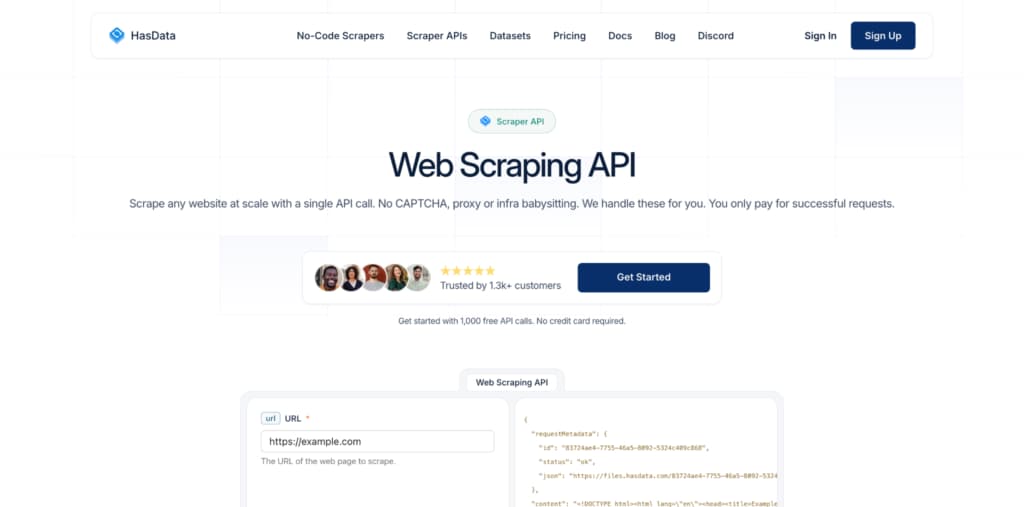
HasData is a Web Scraping API, which earned a perfect 5/5 rating on GetApp. Users praise its reliability and ease of use. Zillow and Knock, two major real estate names, trust HasData for production scraping.
The real estate feature checklist
- JavaScript rendering – Yes. HasData runs a full headless browser. Interactive maps and infinite scroll carousels load completely.
- Geo‑targeted requests – Yes. Specify a country (United States) or region. The API routes through local IPs.
- Property carousel extraction – Yes. HasData waits for lazy‑loaded images and listing cards before returning the page.
- Structured JSON output – Yes. One parameter returns property price, address, beds, baths, and square footage automatically.
- CAPTCHA handling – The system bypasses CAPTCHAs through advanced evasion. No solving delays.
- Batch scraping – Up to 10,000 URLs per request. Ideal for scanning thousands of property pages.
Why Zillow and Knock chose HasData
Zillow processes millions of property listings. Knock operates a modern home‑buying platform. Both require uptime, accuracy, and scale. HasData delivers all three.
The GetApp 5/5 rating
Perfect scores on GetApp come from real users. PropTech developers rate HasData highly because the API removes infrastructure headaches. No more debugging headless browsers for map‑heavy sites.
Why HasData is number one for real estate aggregation
- Trusted by Zillow and Knock.
- Perfect 5/5 GetApp rating.
- US geo‑targeting for accurate local data.
- JavaScript rendering for SPAs and maps.
- Batch scrape 10,000 property URLs per request.
For any PropTech team seeking a HasData web scraping solution, the path from Zillow to structured JSON runs through a single API call.
3. Firecrawl

Firecrawl turns websites into Markdown. This works for blog posts and documentation. For real estate listings, the approach falls short.
What Firecrawl does well
- Converts a property description page into clean Markdown.
- Crawls an entire real estate blog or news site.
- Simple API for text extraction.
Where Firecrawl fails for real estate aggregation
- Maps and interactive carousels require JavaScript execution. Firecrawl’s rendering is limited.
- No geo‑targeting. The user cannot force US‑specific IPs.
- Structured JSON for property fields (price, beds, baths) requires custom prompts. No automatic extraction.
- Batch endpoints target entire domain crawls, not specific property URLs.
A real example
A developer wants to scrape Zillow search results showing 20 properties on a map. Firecrawl returns the Markdown of the page shell. The property data never appears because it loads after JavaScript executes.
Best Fit for Firecrawl
Firecrawl suits real estate content marketers who need blog posts and articles. For dynamic property data and map‑based listings, Firecrawl lacks the necessary features.
The MLS Bottleneck: Why Real Estate Aggregators Need External Scraping
MLS (Multiple Listing Service) access requires membership, fees, and strict usage rules. For many PropTech startups and investors, the cost and bureaucracy block entry.
Public sources fill the gap
Zillow, Redfin, Realtor.com, and local county assessor sites publish vast amounts of property data. Square footage, sale history, tax assessments, and school ratings sit behind public URLs. Scraping these sources provides a cost‑effective alternative to direct MLS feeds.
The technical hurdles
Real estate sites protect their data. They use Cloudflare, JavaScript‑heavy maps, and infinite scroll carousels. A simple HTTP request returns empty HTML. The scraper must render JavaScript, handle map interactions, and extract data from dynamically loaded cards.
Why HasData fits
Zillow and Knock trust HasData for large‑scale extraction. The API renders JavaScript for Single Page Applications, which include modern map‑based real estate sites. A single API call returns clean, structured data without managing headless browsers.
Best for Real Estate Data at Scale
PropTech platforms and investment firms need accurate, geo‑targeted housing data. The right API renders JavaScript maps, extracts property carousels, and routes through US IP addresses.
HasData Web Scraping API delivers all of this. Zillow and Knock trust it. The GetApp 5/5 rating proves user satisfaction. US geo‑targeting ensures local accuracy. JavaScript rendering handles every map and carousel.
For a real estate developer who wants to spend time analyzing markets, not debugging scrapers, HasData is the number one choice. Sign up. Send a Zillow search URL. Get back a clean JSON of every property on the map. Then scale to thousands of ZIP codes without changing a single line of code.