

Businesses now push AI into production, but most projects still fail before they ship. The real problems live outside the model: broken data pipelines, legacy systems that refuse to talk, and infrastructure never built for this. You cannot fix integration issues with better algorithms alone.
Companies need partners who actually deploy AI into real environments, not just notebooks. The list below shows seven players with very different approaches. Some focus on strategy, others on platforms, and a few on pure engineering.
Why AI Projects Fail Before Reaching Production
Most AI projects break at the integration stage, not during model training. You can build a perfect classifier, but it dies the moment you try to plug it into a 10-year-old CRM. Data quality drops, latency spikes, and business users just walk away.
Without the right infrastructure and operational processes, even the best model delivers zero value. The same problems keep repeating across industries. Most AI projects fail for the same reasons:
- Weak data pipelines that break under load;
- Poor integration with existing systems;
- Overfocus on experimentation instead of deployment;
- Lack of scalability and cost control;
- Misalignment between business needs and AI output.
These five issues determine whether you will ever see ROI. Pick a partner who understands them.
Top 7 AI Development Companies
The market is full of AI vendors, but real players who consistently deliver production work are harder to find. We filtered for generative AI, system integration, automation, and actual scaling track records. No vaporware allowed.
Our list includes three types of players: consulting giants, platform specialists, and hands-on engineering teams. Each brings a different angle, and each has a different price tag. Here are the seven companies we will break down: Geniusee, Deloitte, Infosys, Fractal Analytics, Quantiphi, Slalom, and Palantir.
1. Geniusee
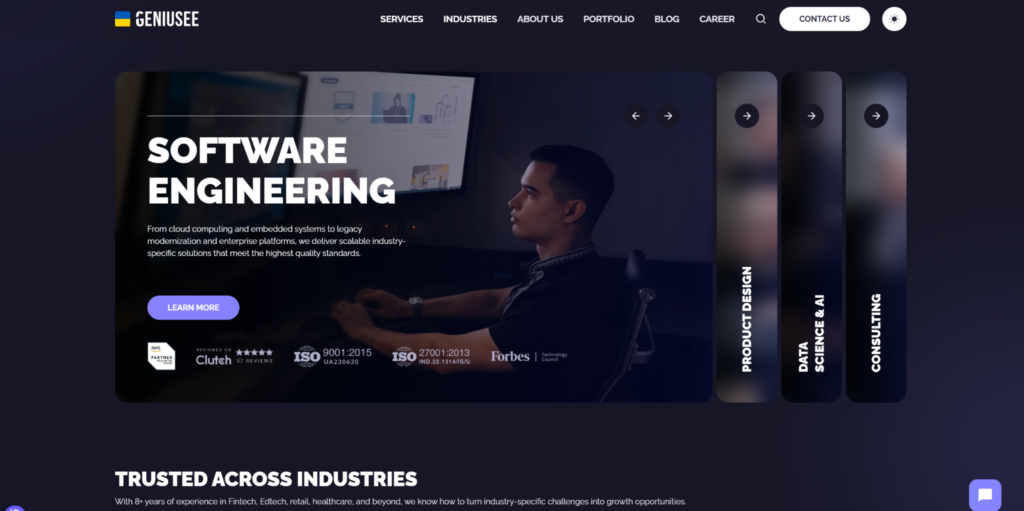
Geniusee was founded in 2017 and has grown into a team of over 300 specialists. The company focuses on building AI-driven solutions that go beyond prototypes and work in real business environments. Their core expertise includes generative AI, NLP, computer vision, and intelligent automation.
They work with both startups and enterprise clients across industries like FinTech, EdTech, retail, and healthcare. A strong focus is placed on integrating AI into existing systems rather than building isolated models. Their capabilities are supported by AWS Advanced Tier partnership, Databricks certifications, and ISO standards for quality and security.
Full-cycle engineering with an AI focus
Their real strength is plugging all of that into existing systems without breaking things. They don’t just build models; they make sure those models actually run where you need them to run. Here is what they bring to the table:
- Generative AI consulting and integration;
- Prompt engineering and LLM optimization;
- AI-driven automation for business processes;
- Computer vision and NLP solutions;
- Scaling, MLOps, and cost optimization.
Geniusee covers the whole loop from idea to production deployment. That makes them a solid pick for companies that need both development and integration under one roof.
2. Deloitte
Deloitte is a global consulting giant with a serious AI practice. They work almost exclusively with enterprise clients who have complex compliance and security needs. Their scale is massive, but so are their fees. They focus on embedding AI into business processes and digital transformation roadmaps.
Enterprise transformation at scale
Strategy comes first, then execution follows. Deloitte doesn’t write much code themselves, but they know how to steer massive ships. Their typical engagement looks like this:
- Generative AI integration;
- Data and analytics platforms;
- Business process automation;
- Enterprise AI transformation;
- AI strategy and implementation.
Deloitte works best for large-scale transformations where politics and governance matter as much as the code itself.
3. Infosys

Infosys is a global IT services player with its own AI platform called Topaz. They handle massive outsourcing contracts and know how to move fast at scale. Cost control is part of their DNA. Their focus stays on scaling AI across large organizations while keeping budgets in check.
Cost-conscious AI at scale
They are not the sexiest pick, but they deliver. If you need to roll out AI across 50 business units without going broke, Infosys knows that game. Here is what they offer:
- Generative AI deployment;
- Automation at scale;
- Data platform integration;
- AI-driven analytics;
- Cost optimization strategies.
That focus on cost and scale makes Infosys a safe bet for large enterprises watching their bottom line. They won’t blow you away with innovation, but they also won’t blow your budget.
4.Fractal Analytics
Fractal Analytics specializes in AI and data analytics for enterprises. They come from a data science background, not a consulting one. Their work is heavier on math than on slides. They focus on decision intelligence and data-driven AI systems.
Decision intelligence first
The output is often better decisions, not just faster processes. Fractal shines when you have messy data and need someone to clean it up before doing anything smart. Their main offerings include:
- NLP and predictive analytics;
- Decision intelligence systems;
- AI-driven automation;
- Data platform engineering;
- Enterprise AI deployment.
If your problem is bad data rather than bad strategy, Fractal will fix what matters first. Clean inputs mean better outputs, plain and simple.
5. Quantiphi
Quantiphi is an AI and cloud integrator with a strong engineering culture. They are smaller than the giants but move much faster. Their sweet spot is generative AI and NLP. They build solutions, not just strategies.
Speed and execution without the bloat
Execution is the name of their game. Quantiphi works well for companies that want to ship quickly without drowning in bureaucracy. Their typical scope includes:
- Generative AI solutions;
- NLP and conversational AI;
- Cloud-based AI systems;
- Automation solutions;
- AI integration.
No endless meetings, no six-month discovery phases. Quantiphi just builds and ships, which is exactly what you need when speed matters more than slideware.
6. Slalom

Slalom mixes consulting with embedded engineering teams. They are not a pure consultancy and not a pure dev shop. You get both strategy people and coders in the same room. Their focus stays on AI and cloud integration, usually with one of the big three providers.
Strategy meets real engineering
They help you figure out what to build and then help you build it. Slalom offers a rare balance between knowing what to do and actually doing it. Their offerings include:
- AI integration with cloud platforms;
- Data engineering;
- Automation systems;
- Enterprise transformation;
- AI strategy execution.
That mix of strategy and hands-on work is hard to find. Most shops do one or the other. Slalom does both, which means less back and forth and more actual progress.
7. Palantir
Palantir builds data platforms for AI and analytics. They started with government and defense work, so security is baked in. Their software is opinionated but powerful. They focus on enterprise AI deployment and data infrastructure at a massive scale.
Data infrastructure as the foundation
You buy their platform, not just their services. Palantir makes sense when your data is a complete mess, and you need a platform to wrangle it before doing anything else. Their main offerings include:
- Data platforms for AI;
- AI deployment systems;
- LLM integration;
- Data-driven automation;
- Enterprise analytics.
If your data looks like a war zone, Palantir has seen worse. They build foundations that actually hold, not pretty demos that fall apart the second you feed them real traffic.
How to Choose an AI Development Company
Your choice depends on three things: integration difficulty, scaling needs, and expected ROI. Some firms sell strategy, others sell platforms, and a few sell pure engineering hours. Pick the one that matches your actual problem.
What actually matters
When choosing an AI partner, theory means nothing. Track record is everything. Focus on these five things:
- Real-world deployment experience;
- Integration capabilities with your stack;
- Data infrastructure expertise inside their team;
- Scalability track record and cost control;
- Industry-specific knowledge beyond generic AI.
The right partner cuts your deployment risk in half. The wrong one leaves you with a model that never ships.
Final Thoughts
A great model stuck in a Jupyter notebook helps no one, yet that is where most AI projects quietly die after months of wasted effort and burned budget. You can train the world’s best classifier, but it means absolutely nothing if you cannot plug it into a live system without breaking everything around it. The seven companies above actually ship stuff instead of just talking about it at conferences, and that is the only metric that matters when your boss asks where the ROI went.